> ## Documentation Index
> Fetch the complete documentation index at: https://stytch.com/docs/llms.txt
> Use this file to discover all available pages before exploring further.
# Get started with Protected Auth
> Use Protected Auth to defend your signup and login flows.
## Overview
If you are using Stytch for [Consumer](/consumer-auth/overview) or [Multi-tenant authentication](https://staging.stytch.com/docs/multi-tenant-auth/overview), you can use Protected Auth to ensure that only legitimate users can access your auth flows.
Protected Auth is a frontend SDK feature that uses [Device Fingerprinting](/fraud-risk/concepts/device-fingerprinting/overview) to block bots and other suspicious activity at signup and login time.
To use Protected Auth, you must use Stytch for authentication. If you use another authentication provider, you will integrate Device Fingerprinting [using the API](/fraud-risk/get-started/using-dfp-api).
This guide shows you how to set up Protected Auth. By the end, you'll have:
* Installed the frontend SDK.
* Turned on **Observation mode**.
* Turn on **Enforcement mode**.
***
## Prerequisites
* [JavaScript](/api-reference/b2b/frontend-sdks/vanilla-js/overview) frontend SDK or mobile SDK ([React Native](/api-reference/b2b/mobile-sdks/react-native/overview), [iOS](/api-reference/b2b/mobile-sdks/ios-sdk), or [Android](/api-reference/b2b/mobile-sdks/android-sdk)) installed. Minimum versions required:
* Vanilla JS SDK: `v2.2.0`
* React Native SDK: `v0.12.0`
* iOS SDK: `v0.18.0`
* Android SDK: `v0.14.0`
* An existing Stytch B2B or Consumer project in the [Dashboard](https://www.stytch.com/dashboard).
* The `project_id` and `secret` for your project's Test environment. These can be found under your project's *Project ID & API keys* section in the [Dashboard](https://www.stytch.com/dashboard).
* Device Fingerprinting [enabled for your project](https://stytch.com/dashboard/dfp-rules).
* If you don't have Device Fingerprinting enabled, you can [request access here](https://offers.stytch.com/dfp-30-day-trial?utm_source=stytch_docs\&utm_medium=direct\&utm_content=dfp_30_day_trial).
## Get started
Follow the [Quickstart](/get-started/quickstart) to get started with the SDK.
Enable **Protected Auth** under [Frontend SDK settings](https://stytch.com/dashboard/sdk-configuration) in the Dashboard:
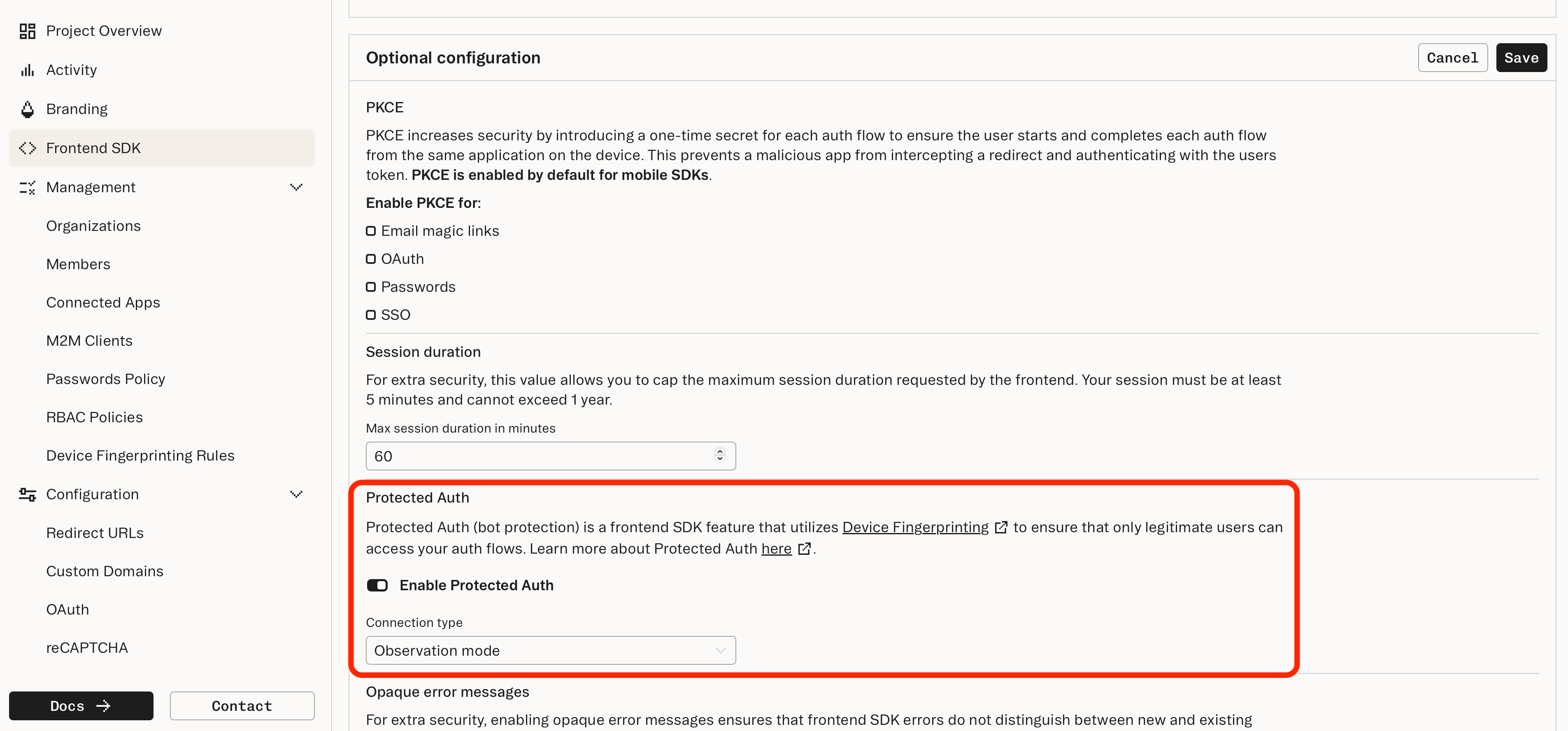 By default, the *Connection Type* is set to **Observation mode** when enabling Protected Auth. This mode:
* Automatically generates and submits a fingerprint to the Stytch API.
* The API will **not** enforce any action.
In Observation mode, you can test Protected Auth on real traffic without risk as it will not block any requests and allow you to analyze the results safely.
Results of automatic fingerprint lookups show up as [Device Fingerprinting Logs](https://stytch.com/dashboard/activity?tab=dfp-logs) in the Dashboard.
By default, the *Connection Type* is set to **Observation mode** when enabling Protected Auth. This mode:
* Automatically generates and submits a fingerprint to the Stytch API.
* The API will **not** enforce any action.
In Observation mode, you can test Protected Auth on real traffic without risk as it will not block any requests and allow you to analyze the results safely.
Results of automatic fingerprint lookups show up as [Device Fingerprinting Logs](https://stytch.com/dashboard/activity?tab=dfp-logs) in the Dashboard.
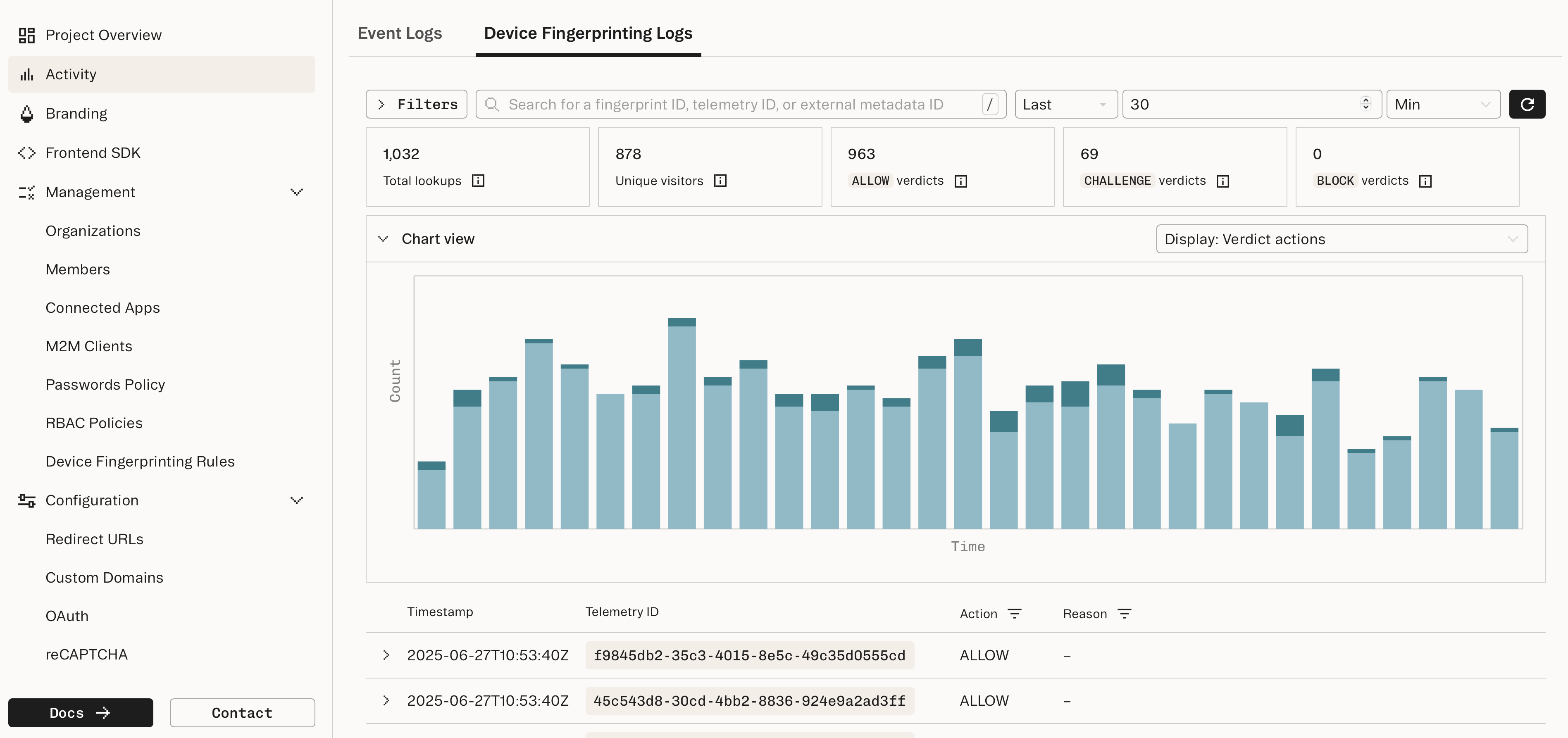 This will give you a high-level view of the various fingerprints, verdicts, and verdict reasons your application is experiencing. You can view details of individual fingerprints to understand the various devices that are querying your service.
Once you are comfortable with the verdicts for your traffic, you can switch the *Connect Type* to **Enforcement mode**. This enables the Stytch API to react to each lookup triggered by the SDK:
* For `ALLOW` verdicts, continue requests in the normal authentication flow.
* For `BLOCK` verdicts, reject requests and return a `401`.
* For `CHALLENGE` verdicts, the default behavior will continue requests as if they received an `ALLOW` verdicts.
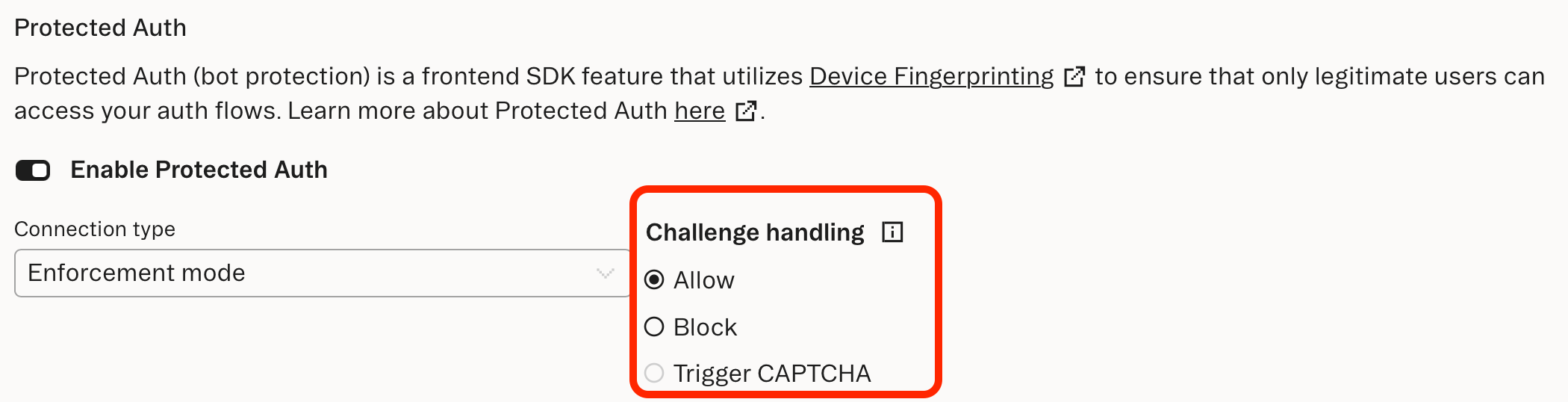
You can configure how Protected Auth [handles challenge verdicts](/fraud-risk/device-fingerprinting/protected-auth#handling-challenge-verdicts) by adjusting the *Challenge handling* setting:
This will give you a high-level view of the various fingerprints, verdicts, and verdict reasons your application is experiencing. You can view details of individual fingerprints to understand the various devices that are querying your service.
Once you are comfortable with the verdicts for your traffic, you can switch the *Connect Type* to **Enforcement mode**. This enables the Stytch API to react to each lookup triggered by the SDK:
* For `ALLOW` verdicts, continue requests in the normal authentication flow.
* For `BLOCK` verdicts, reject requests and return a `401`.
* For `CHALLENGE` verdicts, the default behavior will continue requests as if they received an `ALLOW` verdicts.
You can configure how Protected Auth [handles challenge verdicts](/fraud-risk/device-fingerprinting/protected-auth#handling-challenge-verdicts) by adjusting the *Challenge handling* setting:
 ## What's next
Learn more about options for handling challenge verdicts.
***
Find out why Stytch's device intelligence is trusted by Calendly, Replit, and many more.
## What's next
Learn more about options for handling challenge verdicts.
***
Find out why Stytch's device intelligence is trusted by Calendly, Replit, and many more.