> ## Documentation Index
> Fetch the complete documentation index at: https://stytch.com/docs/llms.txt
> Use this file to discover all available pages before exploring further.
# Modeling your app
> Multi-tenancy vs. consumer (single-tenancy) data models.
export const userTip = "Represents an end user's account in your application.";
export const member = "Represents an individual end user's account within a given Organization, uniquely identified within that Organization by their email address.";
export const organization = "Represents an instance or tenant in your application, typically mapping to each of your top-level customers.";
## Overview
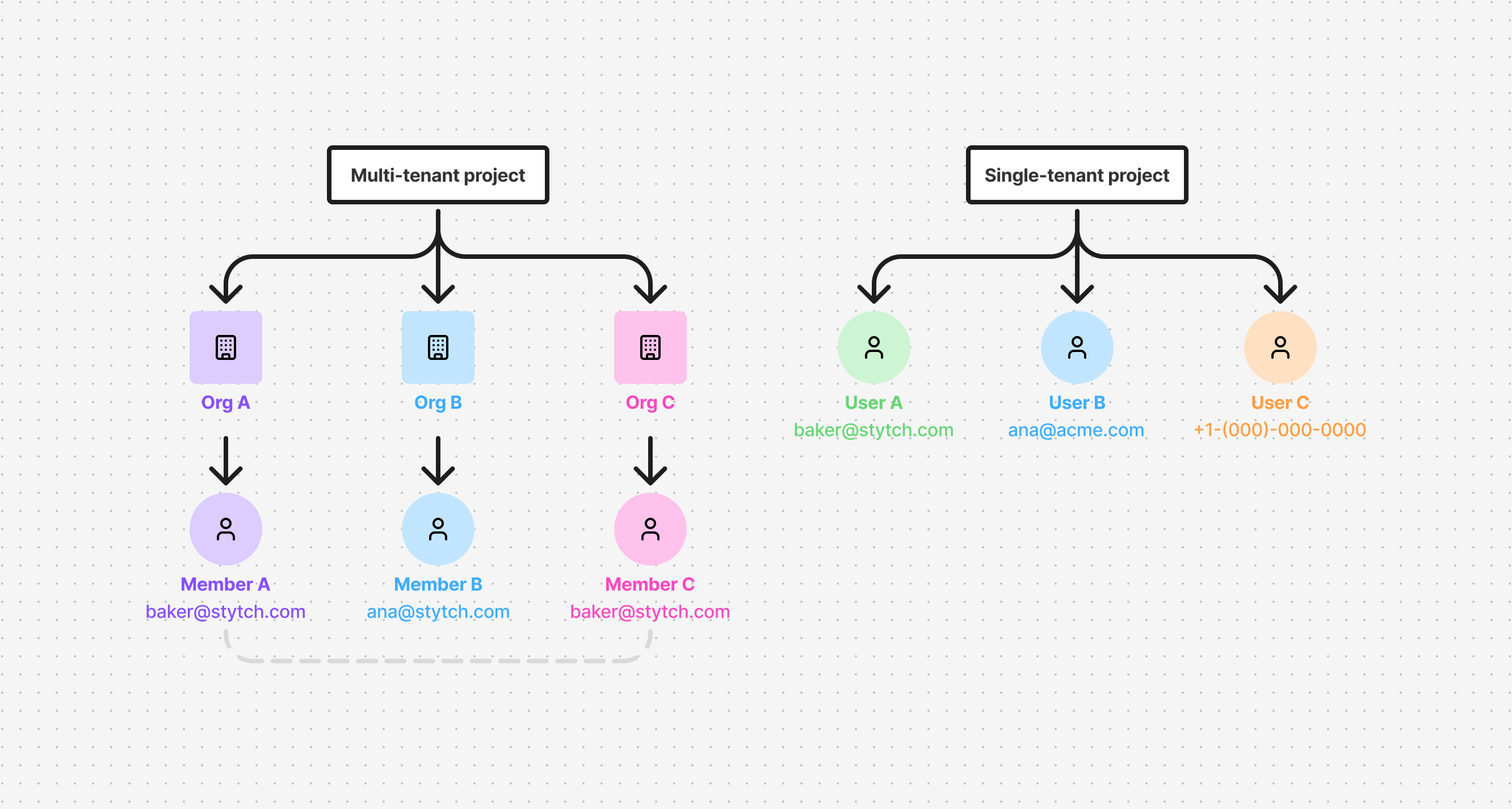
You must select between **multi-tenant** or **consumer** data models when creating your Stytch project. This both defines who "owns" end user data and sets which SDKs and APIs your project has access to.
Common for B2B SaaS where users exist as members to one or more organization.
*Uses B2B API & SDKs.*
Single-tenant model where users exist as individual users **without** organizations.
*Uses Consumer API & SDKs.*
## Model diagram
 ## Why this matters
Different application use cases have different auth needs. For example, the Consumer API is designed for simplicity and works well for apps that don't require complex identity management features like SSO or SCIM—which are more commonly needed for B2B SaaS apps. Unique identifiers for end users are also slightly differentiated:
* In multi-tenant auth, a member is identified by their email.
* In consumer auth, a user is identified by either email or phone number.
## Need a hybrid model?
If you have a mix of business customers and individual end users, **we recommend using multi-tenant auth** and creating an organization behind the scene for each individual user “tenant” in order to allow these single-player accounts to seamlessly upgrade and add potential collaborators in the future.
## Why this matters
Different application use cases have different auth needs. For example, the Consumer API is designed for simplicity and works well for apps that don't require complex identity management features like SSO or SCIM—which are more commonly needed for B2B SaaS apps. Unique identifiers for end users are also slightly differentiated:
* In multi-tenant auth, a member is identified by their email.
* In consumer auth, a user is identified by either email or phone number.
## Need a hybrid model?
If you have a mix of business customers and individual end users, **we recommend using multi-tenant auth** and creating an organization behind the scene for each individual user “tenant” in order to allow these single-player accounts to seamlessly upgrade and add potential collaborators in the future.