

Custom email templates require purchasing the Full email customization and Stytch brand removal add-on. See Stytch’s Pricing page for more details.
Setting up custom email templates
Complete the following steps to set up and use a custom email template in your Stytch requests.1
Enable the email and branding customization add-on
Stytch’s Full email customization and Stytch brand removal add-on is required in order to use custom email templates. You can enable this add-on in the Optional Add-Ons section of the Billing page in the Stytch Dashboard.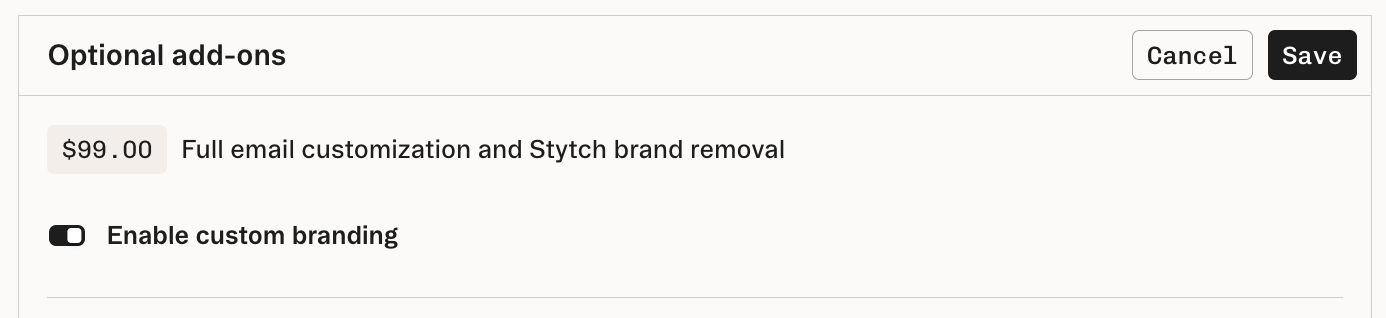
2
Set up a custom email domain
Next, set up a custom email domain for sending Stytch emails by following the setup steps in the Custom email domains section of the Stytch Dashboard..Note that in order to protect our domain reputation, it is not possible to send custom email templates from the default Stytch sender domains. Learn more about custom email domains here.
3
Create a new custom email template
Now that your custom email domain is set up, you can create a custom email template by navigating to the Branding tab in the Stytch Dashboard and clicking Create new template.In the Template type dropdown, select Custom HTML template.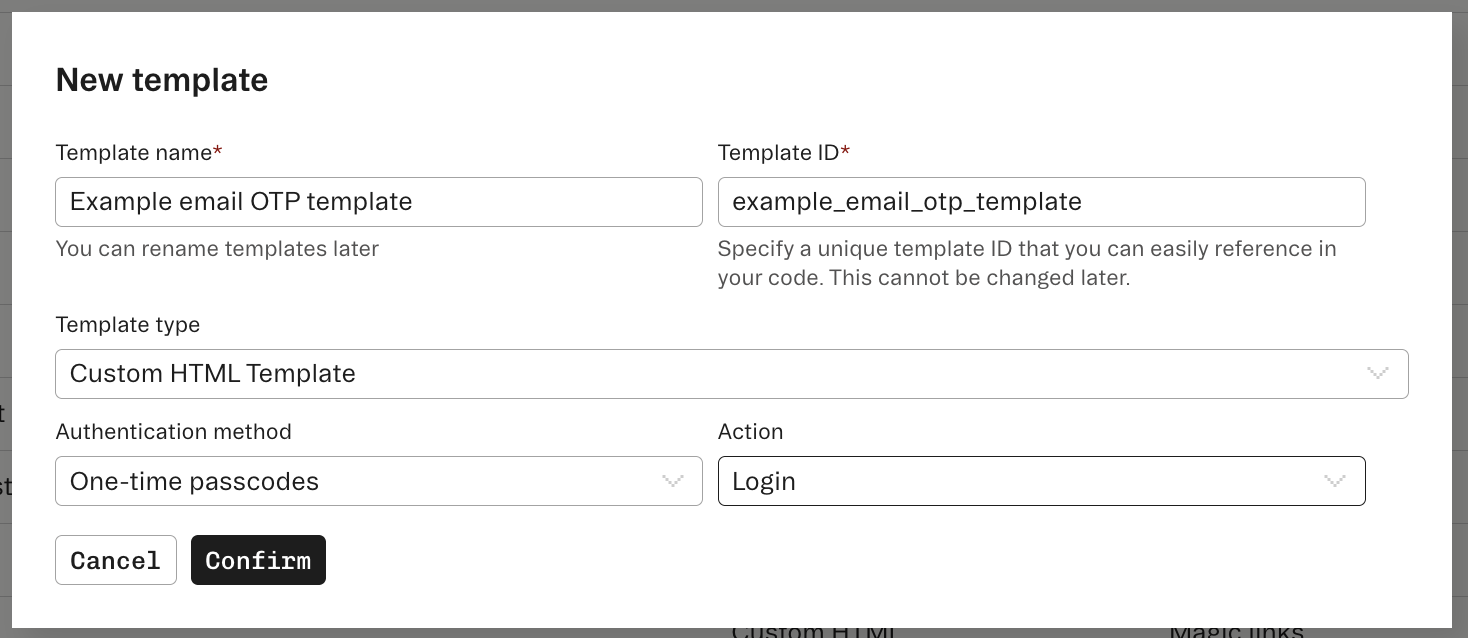
magic_link_url, otp_code, user_email, etc. into your template. Note that the available variables depend on the email template type and specific authentication flow, and not all variables are available in all contexts.Alternatively, you can use our Programmatic Workspace Actions endpoints or our Terraform provider to create and manage your custom email templates.4
Use your custom email template in Stytch requests
Once you’ve finished creating your custom email template, you can instruct Stytch to use it by specifying its For Send Discovery Email OTP in B2B auth:You can also set a custom email template as the default template for its specific template type. When an email template is set as the default, we’ll send that template to the user if you don’t specify a
template_id in your authentication requests. Stytch endpoints that trigger an email include parameters like login_template_id, signup_template_id, and reset_password_template_id where you can specify the template_id of your custom email template.Here are some example requests that specify a custom email template via the login_template_id parameter:For Send OTP by Email in Consumer auth:template_id in your request.